




The world's first AI model that understands repair

Interpreter is Partly's foundation model, bringing AI to the automotive repair industry.

Built by AI researchers and automotive veterans

Made for modern repair

Vehicle repair has never been more complex. Getting every job right requires accurate information on the vehicle, parts and damage, and the specialist knowledge to apply it.

Interpreter is Partly's foundation model for exactly this, trained on five years of original research across millions of vehicles and billions of parts, and annotated by experienced parts interpreters.

It advances the repair industry by speeding up repairs, reducing errors, and eliminating busywork.

Model Card

Model Information
Description
Interpreter is Partly's general-purpose language model for the automotive repair industry.
Inputs
Text, photo, video, and voice.
Outputs
Text tokens.
Architecture
A multimodal model trained to reason over automotive parts data and repair workflows.
Model Data
Training Dataset
Extensive proprietary research conducted in-house, combined with licensed data and reinforcement learning on historical repair data.
Annotation
Annotated by experienced parts interpreters using purpose-built in-house tools.
Evaluation
Approach
Parts-list accuracy on held-out production repair jobs, scored as an estimator working with each tool, against a current-tools baseline and frontier models.
Results
An estimator with Interpreter reaches 98.8% parts-list accuracy, against 92.1% with current tools. Frontier models score in the single digits on their own.
Usage & Limitations
Intended Use
General-purpose assistance for parts identification, repair guidance, and repair workflows across collision, mechanical, and dismantling.
Out of Scope
Vehicles beyond passenger and light commercial; markets outside North America, EU, AU, and NZ.

Model Capabilities

Comprehension

Reads a repair job the way an estimator does, including trade shorthand, jargon, and voice notes.

Resolution

Reasons over complex relationships to resolve a job into the exact, purchasable part.

Auditability

Shows the reasoning behind every part it recommends, with confidence scoring.

Agentic

Plans and works through a job, taking action as it goes.

Worked Examples

We've taken a few real-world scenarios to show how Interpreter resolves complex repair jobs.
Scenario 1

Assembly trees

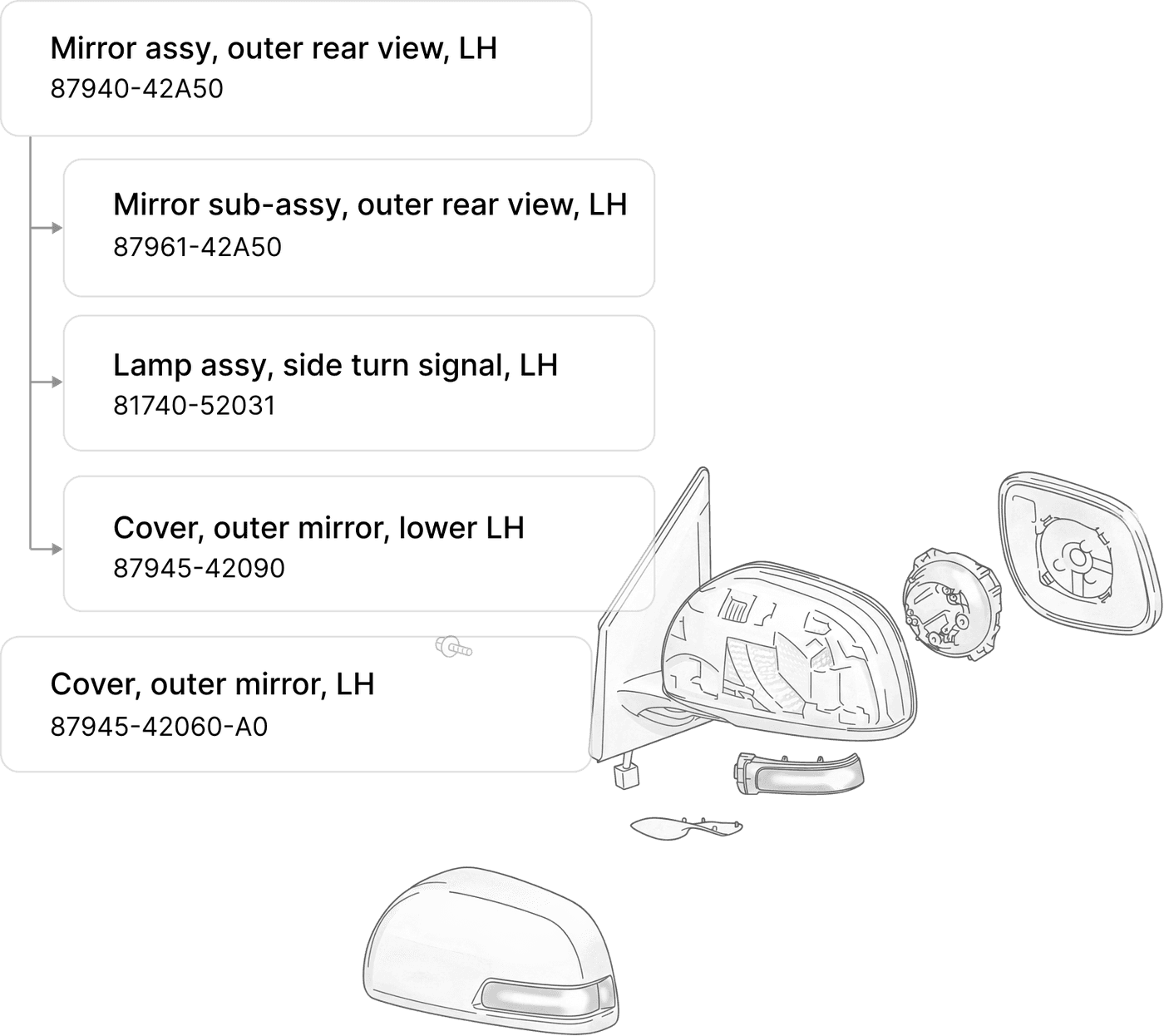
Parts are often structured as assemblies, which are purchasable collections of parts.

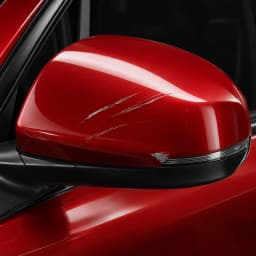
Take a Toyota wing mirror. The whole unit is made up of the mirror sub-assembly, the side turn signal lamp, the outer cover, and the lower cover. Depending on the damage, a repairer might want to buy the whole assembly, or just the parts the job needs. Which level they can actually buy varies from supplier to supplier.

Interpreter standardizes the assembly's structure, then weighs what each supplier offers, including price, against what the repair needs, so a repairer can order at the right level.

Scenario 2

Grouped supersessions

A supersession is when a manufacturer retires a part number and points it to a replacement. Some are one-to-one, a part swapped for its direct successor. Others are more complex, and a group supersession is one of them: a single discontinued part replaced by a group of several current parts.

Take a rear bumper cover for a 2013 Toyota Camry. The build sheet lists part 5215933330B0, but the manufacturer has since split that assembly into three separate parts: the cover and its left and right insulators.

Resolving a supersession like this usually means manual research by the supplier, with high room for error. Repairers commonly buy one part from the group and miss the others, forcing a supplementary order.

Interpreter flags the supersession and surfaces all three current parts, so nothing gets missed.

Scenario 3

Repair economics

The true cost of a job is more than the part price, it includes labor, paint, and factors like shipping, cycle time, business incentives.

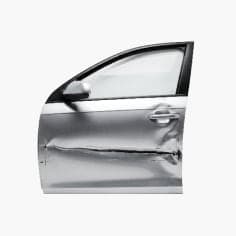
A repairer needed a replacement door. On sticker price, the used door looked $136 cheaper. Interpreter knew the vehicle's paint code, estimated the cost of color-matching the bare part, and compared the true painted cost of each option, so it recommended the OEM door.

Model Performance

We benchmarked Interpreter in the hands of an estimator, on real repair jobs.

Build with Interpreter

Enterprise-grade infrastructure with developer-friendly tools and comprehensive documentation.

API Docs